The morning of December 17, 1903 was cold and unforgiving.
Wind cut across the dunes of Kitty Hawk, North Carolina at nearly 27 miles per hour. The temperature hovered just above freezing. Five witnesses stood in the sand — a handful of local men who had no idea they were about to watch the world change forever.
Orville Wright climbed aboard a fragile machine made of spruce, ash, and muslin. A 12-horsepower engine. Two propellers. A dream that most of the world had already dismissed as madness.
At 10:35 in the morning, the Flyer lifted off the ground.
For 12 seconds, it stayed there.
120 feet. Less than half the length of a modern commercial aircraft. A distance most people walk without thinking twice.
And yet nothing was ever the same again.
I named the company 1903 not because it was a year of perfection — it wasn't. The Wright Flyer was fragile, temperamental, and barely controllable. It was a beginning, not a destination.
I named it 1903 because of what that year represents. The courage to attempt something the world said was impossible. The discipline to spend years preparing for 12 seconds. The understanding that every great journey begins with a single, terrifying, beautiful first.
First Flight isn't just the name of our watch.
It's a philosophy.
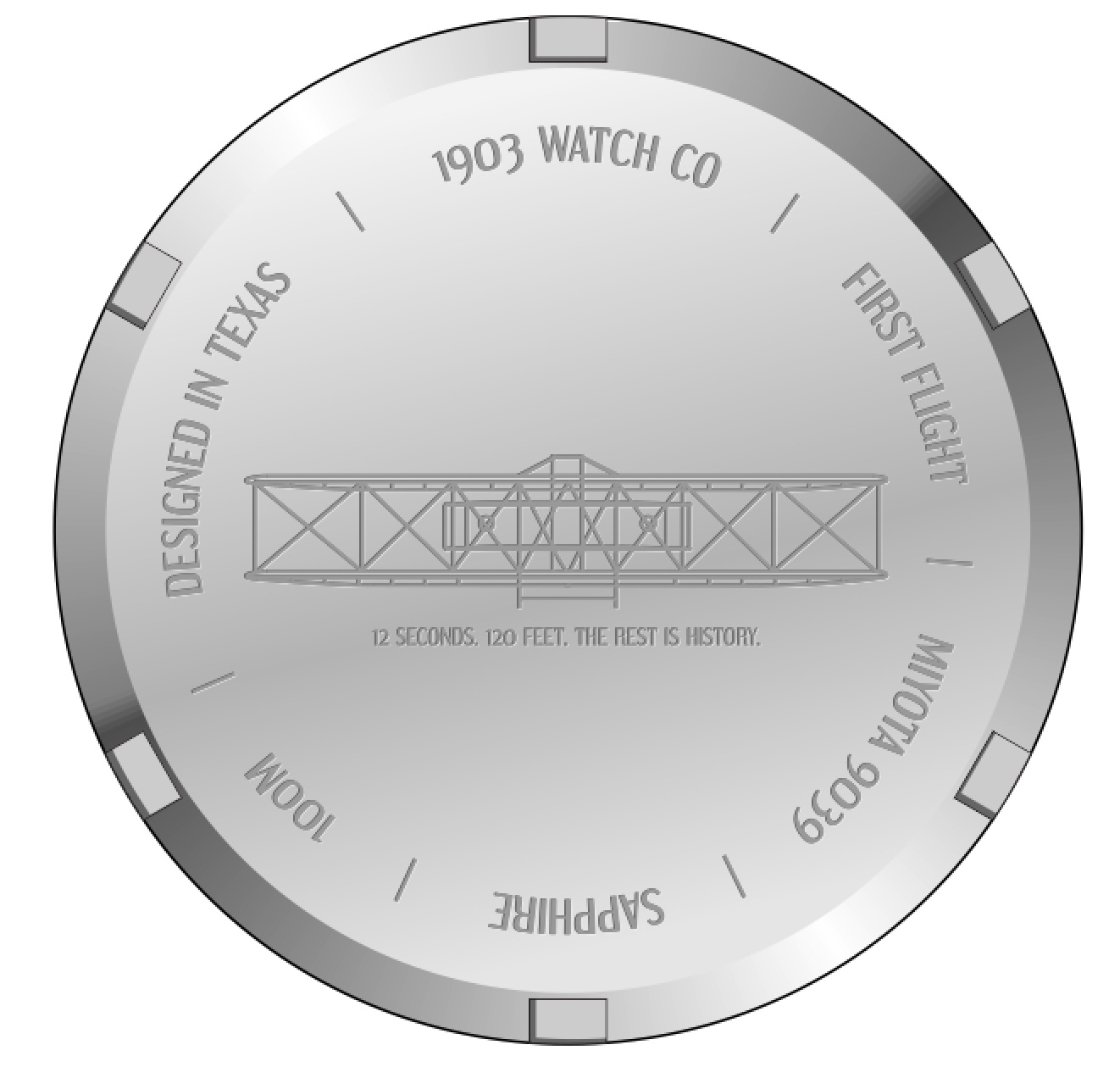
On the caseback of every First Flight sits the Wright Flyer — not as decoration, but as a reminder. A reminder that 12 seconds changed everything. That 120 feet was enough. That the rest, as they say, is history.
We carry that spirit in everything we build. In the 316L stainless steel case. In the Miyota 9039 movement beating 28,800 times per hour. In the domed sapphire crystal that lets you see time clearly, regardless of the angle.
And in the words etched into the steel you'll wear on your wrist:
12 Seconds. 120 Feet. The Rest Is History.