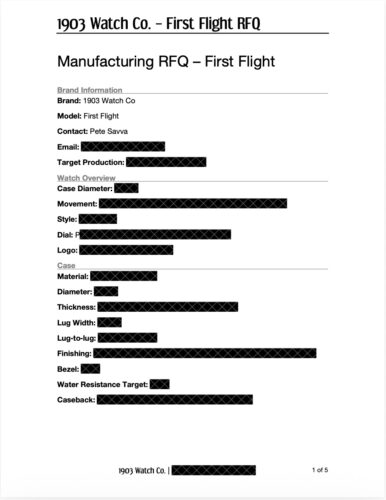
With the design far enough along, I started reaching out to manufacturers. It felt like a natural next step. Send some messages, get some quotes, figure out what's possible.
The first few replies taught me something quickly: nobody can help you if you don't know what you're asking for.
A watch isn't one product. It's five or six separate manufacturing conversations happening at once — case, dial, hands, movement, finishing, assembly — each with its own suppliers, lead times, and language. Saying "I want to make a watch" is a bit like calling a builder and saying "I want a house." Technically true. Completely unhelpful.
Vague questions get vague answers. The quality of the response is almost always a reflection of the question that came before it.
So I stepped back. Learned how to write a proper RFQ. Understood what specifications actually meant in practice — not just dimensions on a screen, but tolerances, finishes, materials, quantities, and how each of those choices affects cost, lead time, and what's even possible.
The more precise the brief, the more useful the conversation — and the faster trust builds with the people on the other end of it.
Making something well and talking about it well turn out to be the same skill, just applied differently. This process rewards both — and doesn't forgive either gap for long.